Utterly immersive debut from 20-year-old director examines the fragmentary and hallucinatory nature of memory and society through an endless series of frustrating, elusive, and creepy rooms in the basement of a discount furniture store.
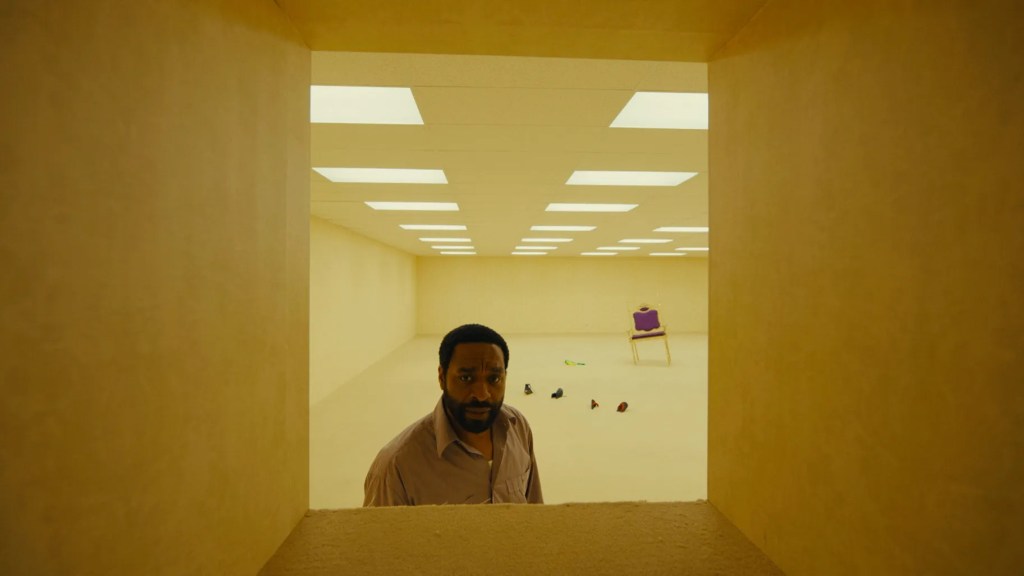
There is something utterly immersive and singular about Kane Parson’s sharp and off-beat directorial debut Backrooms. Which, given the film’s origin in a single photograph shared on a thread on the website 4chan, is not entirely surprising. The original picture is of a large abandoned space, soaked in a ghoulish yellow from carpet to garish wall paper. In its mood and possibilities it is a perfect encapsulation of the liminal space aesthetic popular on the internet, fueled by an uncanny intrigue in empty and something’s a bit off rooms, corridors, and hallways. The film is the exploration of this precise aesthetic – its feeling, mood, and uncomfortable atmosphere – with the calmness and precision of a cave diver, deeper and deeper, darker and darker. You get the sense that Parson’s has lived, breathed, and grown-up in these rooms, and in a sense, he did, making his first films based on the Backrooms at just 16 and putting them on Youtube. Now, thanks to an astute gamble on the 20-year-old, we get to live in them too.
Set in the 90s, Clark (Chiwetel Ejiofor) is a failed architect running a budget furniture store, overworked and understimulated, lonely and exasperated. He clings to the pain of separating from his wife, unable to reflect on his own part in their break-up and instead simmering with rage and bitterness medicated with alcohol. We learn about this through sessions with his calm and polite therapist Mary (Renate Reinsive), who gives off an impression of solidity and balance, but is herself haunted by childhood memories of her mother. In different ways, they both suffer from a lack of depth and introspection, Mary pedaling self-help tapes and Clark dressed-up in humiliating TV adverts, caused by an inability to confront what is troubling them from within.
And so, through a wall in the basement of the furniture shop (the dismally named Cap’n Clark’s Ottoman Empire) Clark discovers a supernatural portal to the Backrooms, and in it whatever troubles them inside becomes terrifyingly reimagined and reproduced in a series of rooms. The Backrooms are an endless series of connected rooms, all with the same dirty yellow carpet and wall papered, all in the same dull surgical light.
The rooms, what they are populated with and what they represent, are the most fascinating and memorable part of the film. A layered network of liminal spaces, where objects such as furniture, road signs, and parts of memories are combined and curated into frustrating, odd, and freaky constructions. Connecting the rooms are trap doors, shoots, and hanging stairs. The set design is amazing, doll’s house precision applied to haunted warehouse scale, making each room unique and uniquely unsettling.
What I found most interesting was the way in which objects and design features were obstructive and frustrating. Chairs block passageways, sofas fill whole rooms, and doors are too small or have three handles. There is of course a metaphor of the rooms and corridors being the memories and paths of the mind, something it shares with The Shining, but the film also has something to say about the way even the objects, and here I am tempted to say commodities, of our life can so easily become strange and frustrating.
After a while, I had the growing sense of these rooms as exhibitions and an artist playing with everyday objects, seeking to turn our attention to them anew, to find them fascinating, dangerous, funny, odd, scary. To challenge the ease in which we integrate them into our life, used to their uses and forgetting their materiality. Their ‘Cold Dark Matter’, as Cornelia Parker called her magnetic artwork of an exploding shed, which I was reminded off. Tracy Emin’s bed, Jesse Darling’s collapsing cabinets, or Rachel Whiteread’s cast mattresses, stairs, and rooms, all share in the film’s interest in the way ordinary objects are remembered and can become remarkable.
Through the backrooms Clark is stalked by something sinister, and there is more than a hint that it is himself that he is going from/to. Mary, in an attempt to help, follows him down into the backrooms. The suspense is masterfully managed by Parson’s, never leaning too heavily on horror tropes or jump scares, but pervading the film with an uneasiness that creates its own kind of horror. Although the script was plodding in parts, and the story was light, the vibe, carried through by two amazing performances by Ejiofor and Reinsive, more than make up for it.
The film is also fascinating for the way it rides a number of currents in our culture. It is part of a small wave of new horror films from young directors who initially produced material for YouTube (Obsession and Iron Lung), which foretells (or forewarns) of one potential direction for the film-making industry. But more than the facts of its production, it’s the overriding atmosphere and popular reception of the film that raises questions: what is it about horror that appeals to so many people at the moment? why does the aesthetic and experience of liminal spaces speak to us?
Backrooms again demonstrates that horror has become safe ground for experimentation, especially for younger directors. This has something to do with the polarisation of many aspects of culture, alongside the shared agreement of what we want to get out of a horror film and the sheer shared enjoyment of watching them together. In other genres, something as experimental, weird, and aesthetically driven as Backrooms would be seen as arthouse and unable to draw in crowds anywhere near what it has done. People are excited about being scared together, but other tastes are more fragmented.
As for our intrigue towards liminal spaces, I can’t help but connect this to a shared sense of the weirdness and irrationality of the world. Thinkers, such as David Harvey, have connected shifting cultural representations and experiences of time and space to the shifts from modernity to postmodernity, and there is clearly something about these Backrooms – haunted, abandoned, out of time and space, off, trapped in memories and twisted nostalgia – and characters – repressed, unfulfilled, unhappy – that speaks to our current moment.
Ultimately, the film is ambiguous whether the Backrooms exist or not, ambiguous even whether Clark and Mary do, or should, prefer this nightmarish environment to the pain of the world. Perhaps it is this questioning of the thin supernatural portal to the Backrooms that is so gripping, might we find some portal? Might we already have found some portal?
Please subscribe below xx
 Dan Does Film Reviews
Leave a comment