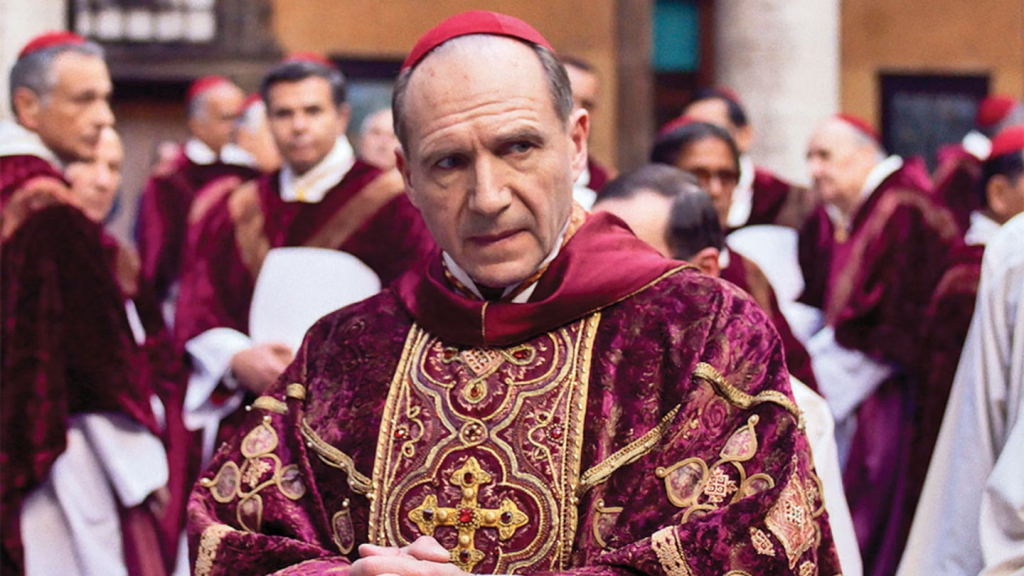
Conclave begins in an ambiguous dawn dark, a cardinal rushing to the Vatican to see firsthand that the Pope has died. From here, intrigue thickens and swirls: death, lies, secrecy, ambition, manipulation, tested faith and man tested. This is the whispered and hallowed world of the sacred assembly of cardinals tasked with electing a new pope. The film plumbs our overarching fascination with the ritual and privacy of the Church and its procedures, while also deftly contrasting the sacred with the mortal and ordinary details that surround them.
At the film’s heart is Dean Lawrence (Ralph Fiennes), a senior figure in the Church trusted by the previous Pope. While suffering from doubts of faith, the responsibility of overseeing the conclave is imposed on him. From an inauspicious beginning, the film picks up pace as the suitability of leading candidates is undermined, ambitions revealed and scorched, schemes devised and foiled, and successive voting rounds fail to produce a favourite, serving only to demonstrate schisms in the Church.
What grounds this holy story is the details that crackle throughout the film, satisfying and deepening our curiosity. The film has a rich texture and immersive sound: fires sizzling, echoing steps reverberating on marble floors, and wax snapping. It oscillates between the sublime and the ridiculous: cardinals scrolling their phone, piles of cigarette butts building up in the break, clusters of cardinals squeezing into minivans, and the toiletry packs distributed to each cardinal upon entering the conclave. It entwines pontification on the nature of doubt to faith with the serving of tortellini, the corroding effects of ambition on the suitability of the papacy to the working of a paper scanner.
Ralph Fiennes is rich and thoughtful as the pragmatically pragmatic Dean Lawrence: the film’s developments run through his inquests and doubts. Weighed down by obligations he no longer wants, he becomes more and more compromised by his role as he is forced to ‘pick sides’ in the strategic and brutal jostling of potential Popes. The pressure mounts: no one does a sharp burst of anger better than Fiennes.
The director Edwards Berger, best known for All Quiet on the Western Front (2022), trusts the audience, showing and telling only what is necessary, and allowing ambiguity to fester. The tight camerawork and frequent use of focus drag us into the claustrophobic and disorientating atmosphere of the Conclave, as it circles in on its central theme of finitude. Human beings are frail, they falter easily, yet the lofty ideals of the church and the immense responsibility of the papacy seem to require the erasure of this facet for its cardinals. The film attempts to bring new perspectives to the centre of this conflict, especially the role of women. The indomitable Sister Agnes, played by the legendary Isabella Rossellini, and the other women cooking and cleaning, play a bigger role here than would be usually expected. However, given this (slight) reorientating of perspectives, it is disappointing that the only significant black character, an African Cardinal, Joshua Adeyemi, played by Lucian Msamati, is defined by his socially conservative and homophobic views.
Of course, the absorbing scandal and machinations get you to the cinema and drive the plot, but it is the courage and intensity of attention to mundanity—the food, the robes, the rooms, the transport—that elevate Conclave. It begins at dawn, with darkness and death, but leaves with light. Windows open and faces turn to the sky to the the famous white smoke (fumata bianca): a new pope.
 Dan Does Film Reviews
Leave a comment