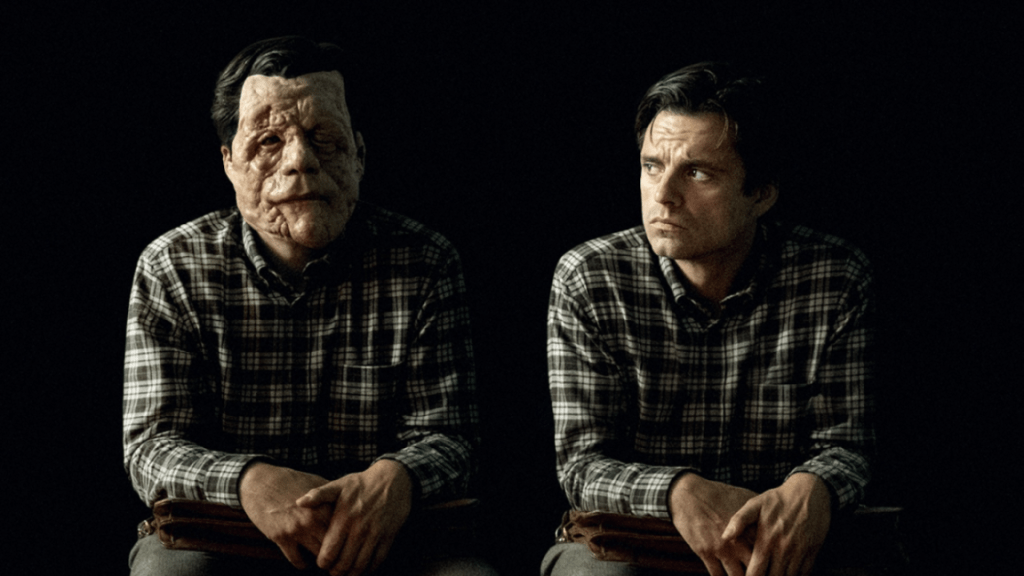
A Different Man boldly explores the tension between inner identity and outward appearance, but becomes muddled by uneven storytelling and underdeveloped characters.

It is as Edward, played by Sebastian Stan in a fire-hazard of prosthetic, begins tearing chunks of his face off that it becomes clear, even through the gaps of my fingers, that A Different Man is as much about a person’s inner as their outer. It thrives on ways these two aspects can align or conflict. Though sprinkled with moments of dark humour, Aaron Schimberg’s film is primarily a psychological examination of Edward and his inability to inhabit his own skin even across such radical changes. It boldly dismantles societal expectations of a marriage between beauty and worth, but inconsistent performances and a jumbled narrative ultimately undermine this intriguing premise.
Edward, a struggling actor living (barely) in New York, has a severe facial disfigurement, caused by neurofibromatosis, which has shrunk him up into himself. His flat is cramped, depressing and leaking water, while his paranoia and shyness mean the outside world offers little relief. He seems content—if not resigned—to being an observer rather than a participant.
Two key events inject life into Edward, spiraling the film into its chaotic second half. First, the unbounded and intrepid playwright Ingrid (Renate Reinsve from The Worst Person in the World) moves in next door, a friendship which blossoms despite Edward’s inability to acknowledge, perhaps even to himself, his romantic feelings for her. Second, an experimental treatment offers Edward a chance to shed his disfigurement, both literally and figuratively. The transformation is existential. Adopting the name “Guy,” the now conventionally handsome Edward declares his former self dead. He embraces the life he believed was denied him: a successful career, romantic relationships, and an attractive apartment.
Despite the furnishings of the life he’d always wanted, internal conflicts between his old and new self emerge. These are exacerbated by landing a part in Ingrid’s off-broadway production playing his former self, and befriending Oswald (Adam Pearson), a man with the same disfigurement, yet who interacts with the world with a warmth and confidence that always and still alludes Edward/Guy.
While visually striking, particularly in its use of light and shadow, and admirable in its depiction and treatment of facial disfigurement, A Different Man is a bit drunk in its storytelling. The major plot points become predictable, while the threads holding the story together unravel. The second half of the film is haphazard and leads to a disjointed ending that muddles any clarity. The film offers moments of insight, but they feel scattered rather than cohesive.
Beyond Edward, the characters are underdeveloped and, sadly, at times irritating. Both Oswald and Ingrid take too long to come into their own, have motivations that are never entirely clear, and feel forced into the story and its situations.
Edward’s fate suggests that selfhood is never only body or mind, but the ongoing struggle to reconcile them, and the threat of failing to do so. Unfortunately, much like its protagonist, A Different Man struggles to balance its own content and form, leaving the film as unwieldy as the character at its centre.
 Dan Does Film Reviews
Leave a comment