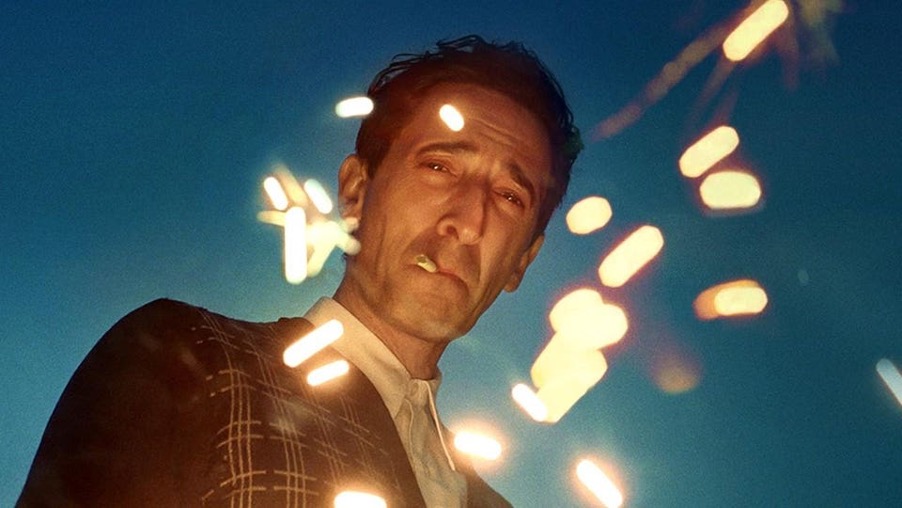
Brady Corbet’s ambitious film about post-war America and the immigrant experience is a triumph of dimension, style, and design – all qualities fitting for a film centred on a visionary architect, László Tóth. Played soulfully and right to the skin by Adrien Brody, in what is surely an Oscar-worthy performance, László is a Hungarian Jew struggling to build a life and make sense of his new surroundings. It is glorious and imposing storytelling, glutted with brilliant acting. Even while it has you reaching for the adjectives ‘monumental’ and ‘epic’, it maintains a grace and depth that easily sustain its 205-minute runtime.
It is a film about movement – a restless movement infused with savage energies. It begins with László arriving on the shores of America, with giddy and woozy shots of The Statue of Liberty, met by his cousin Attila. Attila takes him into his house and gives him a job in his furniture business. Attila has ingratiated himself into American life, opened a small business, changed his surname, and ‘converted’ to the Catholicism of his wife. However there is unresolved tension between the two of them, exasperated by Atilla’s wife, and shortly after arriving László is forced to move out.
László is then taken under the patronage (or charity) of the rich businessman Harrison Lee Van Buren. Van Buren’s dim and deceitful son, Harry, employs Attila and László to refurbish his father’s library while the elder Van Buren is away. However, Van Buren comes home early in a fit of rage and lambasts the workmen before throwing them out of his house. Only later, at László’s lowest, and after discovering the acclaim that László has as an architect back in Europe, does Van Buren, Magpie-like, pluck László out of obscurity and shower him with money and backing. However, the relationship is fraught and turbulent. Though László is given a large commission that re-orientates his life, he becomes beholden to the whim of the intensely jealous Van Buren and his arrogant son. Van Buren can barely contain his disgust at the talents of László being in his body, and this jealously burns with violence.
Guy Pearce and Joe Alwyn are superb as this father-and-son duo, brimming with unresolved anxieties and disappointments. Pearce is pompous and desperate as Van Buren, with a self-assertive voice attempting to cover up a self-loathing and hubris never registered consciously but diverted erratically and dangerously. While Joa Alwyn is fat-headed and quick to outbursts as the unloved and emotionally stunted Harry.
Van Buren’s project is to build a vast community centre for the town – with a chapel, gymnasium, library, and theatre. It is an ego project – merely a means to further express his wealth – and an unconvincing attempt to overcome his mediocrity. The mighty brutalist monument is meticulously planned by László, but dark and uncontrollable aspects of progress – power, corruption, and violence – interfere with its construction. The locals are distrustful of László’s heritage and religion, while others on the project question his methods and materials.
Meanwhile, Erzsébet Tóth, László’s wife and a journalist, played quietly but firmly by Felicity Jones, and Zsófia, his orphaned teenage niece, played by Raffey Cassidy, must also find ways to live again. Indelibly bonded by their experience in Europe, they all struggle to heal and move forward together.
But it is not just this movement of people which the film is interested in. It is also immersed in the movement of industry, of capitalism, of modernism: the movement of steel and concrete, of trains and cars, of the highway and the construction site, of money and plans and designs and investments. It captures the immense, restless movement of post-war America, a society bruised by war but invigorated by its exiles, where all things have a price, even integrity and genius. The movement, so presciently described by Marx a century before, is one that digs, and builds, and forges, and deals, until: “all that is solid melts into air”.
At times, the film grasps us with our yearning for its movement to be progress, for it to lead upwards, onwards, free, more and more and more. But it warps this yearning, it shows the movement to be without purpose, hollow, without meaning. It is a movement haunted, just as its central characters are, by the horrors of the war in Europe and the Nazi’s persecution of the Jews.
László is not a great man of history, but an ordinary survivor who must find a meaningful way to live after surviving something unimaginable. He is confronted with the ugliest aspects of 20th-century America, at least as it presents itself to outsiders: racism, drugs, violence and rape. These aspects are only compounded by the glaring inequality between László’s limited means of control and the power of Van Buren and the high society he surrounds himself with.
The film mirrors its subject. It is exciting and mesmerising, but unsettling and nihilistic at times. This takes away nothing from its achievement as a piece of film though. Its dizzying scope is backed up by beautiful camerawork and exceptional locations. It leaves you reaching for words like ‘monumental’ and ‘epic’ because that is what it is.
In the film’s final words, credited to László, “It is not about the journey but the destination”. The Brutalist is about neither the journey nor the destination, but the movements needed to sustain either, and one man’s attempt to build something solid while all else turns to air.
 Dan Does Film Reviews
Leave a comment