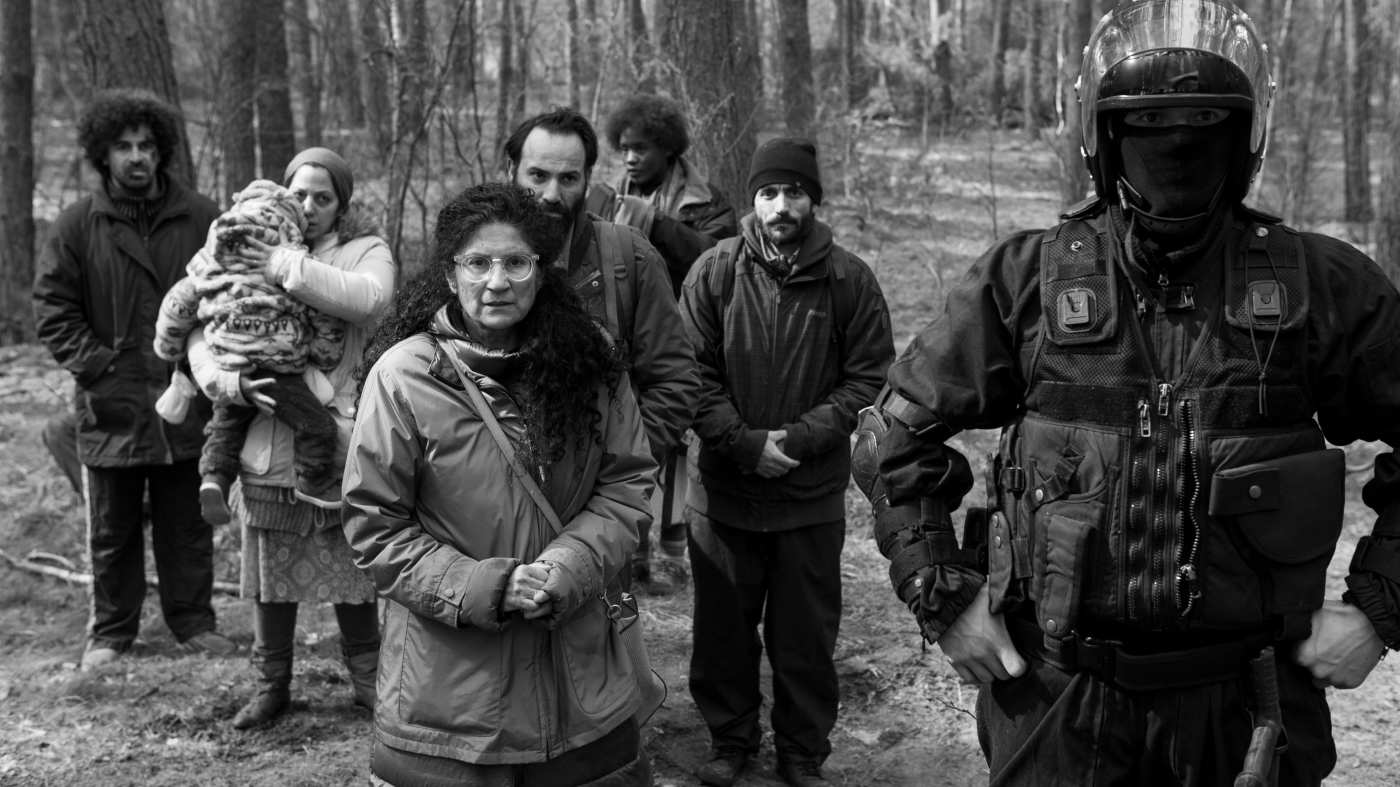
Agnieszka Holland’s tender hammer of a film Green Border, set amongst the perilous and swampy forests between Poland and Belarus, has sparked condemnation from some within the Polish political establishment, especially Poland’s ruling Law and Justice Party. The Minister of the Interior and Administration, Mariusz Kamiński, flippantly dismissed the film as a “brutal attack on Polish uniformed officers [who are] defending not only Poland but also Europe”. But the film is best understood as a cry back: Defending? Who needs defending from desperate refugees?
Situated in the Białowieża Forest, the ‘green border’ and exclusion zone between the Polish and Belarusian borders, the film is saturated with the militarisation and cruel consequences of the wider European ‘migrant crisis’. The toxic political environment remains implicit as the film powerfully foregrounds the brutalising logic of border as a state of emergency, border as a warzone, border as an existential barrier, and the resulting brutalisation of all those who come within its orbit. The spectre, off-screen but orchestrating, is the Belarusian president Alexander Lukashenko, who has been cynically encouraging migrants to cross from Belarus to Poland to gain access and safe asylum in the European Union. This strategy, buoyed by the cronyish support from Putin, aims to destabilise and instil fear in an increasingly xenophobic E.U. In response, the Polish Border Guard has quadrupled in size and begun employing ‘push-backs’ to illegally return migrants to Belarus, only for them to be violently forced back into Poland, to be violently pushed back into Belarus. And so on. While Tarkovsky’s liminal zone in Stalker was haunted by desire and fulfilment, Holland’s is a porous yet strictly contained area of barbed wire, dog bites, and batons. A tango of terror and anguish, where rationality hardens into irrationality, and violence becomes defence and defence violence.
Holland smartly explores this environment through a cast of perspectives that layer and bruise and mingle together – spiralling like coins sucked down a wishing well into oblivion. The moral heart of the film is a multi-generational family fleeing persecution from the Islamic State in Syria. Bashir and Amina (Jalal Al Tawil and Dalia Naous), under the direction of Bashir’s family member in Sweden and under the impression this border is a safe route, are accompanied by their three children and Bashir’s elderly father. The bonds of family are stretched as their attempts to survive the violent to-and-fro between borders fray their relationships and bring them into union with other refugees from Afghanistan and Africa.
Interlaced is the story of Janek (Tomasz Wlosok), a Polish border guard and proud father-to-be. While his superiors casually encourage him to see the cast of desperate refugees as mere weapons in a war against Poland, the film explores the psychological drain of the shame and contradictions involved in maintaining unjustifiable distinctions between human beings.
Meanwhile, activists risk repression, violence and imprisonment to help refugees receive food, water, clothing, essential medical aid, and legal advice. The film allows their own tensions to rise to the surface, as differences in the way risks, responsibilities, and blame are balanced causes rifts and inspires unlikely allies. Maja Ostaszewska is excellent as Julia, a psychologist, whose experience of the border crisis leaves her unable to compromise any more.
The film settles early into its washed-out black-and-white colouring that harmonises and emphasises the grim and gruelling spectacle. Racial abuse, dehumanisation, violence and degradation are normalised and weaponised as acts of bravery and necessity. The lessons are not cheap, easily won, or easily digested. Holland, known for exploring the anxieties and political landscape of Europe in Europa Europa, avoids the pitfall of letting a political message run roughshod over the qualities of the film. The blurred but real lines between political art, propaganda, and the aestheticization of suffering will be cynically exploited by some. Mariusz Kamiński complained that the film “consciously manipulates our emotions”, while the Justice Minister Zbigniew Ziobro, writing on X, has shamelessly compared the film to Nazi propaganda. But while Holland wreaks havoc on our emotions, she never makes the sacrifices or compromises of propaganda. The film maintains a steely eye on reality without becoming falsely stuck in a message, it exposes different perspectives and allows complex characters to navigate the effects of the current situation, and it doesn’t hollow out characters in the pursuit of a political narrative.
This is bombastic filmmaking, well-paced and balanced, and shot with immense compassion. A film with something to say about the past, the present, and the future. An heir to Italian Neorealism, Green Border captures our current political climate of cruelty through its effects on the lives of ordinary people, only stopping in moments to puncture this mood by the indefatigable human propensity to imagine something better. It ends on a disquieting juxtaposition, a further question: border guards are shown accepting refugees, cradling babies in their arms, and compassionately directing refugees to their allotted transport. The change of heart? The refugees in this case were Ukrainians fleeing the Russian invasion, and there was no need to defend Poland and Europe from these migrants.
 Dan Does Film Reviews
Leave a comment